What Trending Emojis Have in Common With the Memes They Fuel
Trending emojis and viral memes run on the same engine. Here's how a tiny symbol travels from niche in-joke to everyone's keyboard.
Something shifts the moment you see खोपड़ी इमोजी in a reply and immediately know exactly what it means. Not death. Not danger. Pure, unhinged laughter. That kind of shared understanding doesn't happen by accident. It builds the same way a meme builds, through the same channels, the same social mechanics, and the same hunger for a shortcut to connection. Trending emojis and viral memes are more related than they appear, and understanding that relationship changes how you think about both.
The Short Version
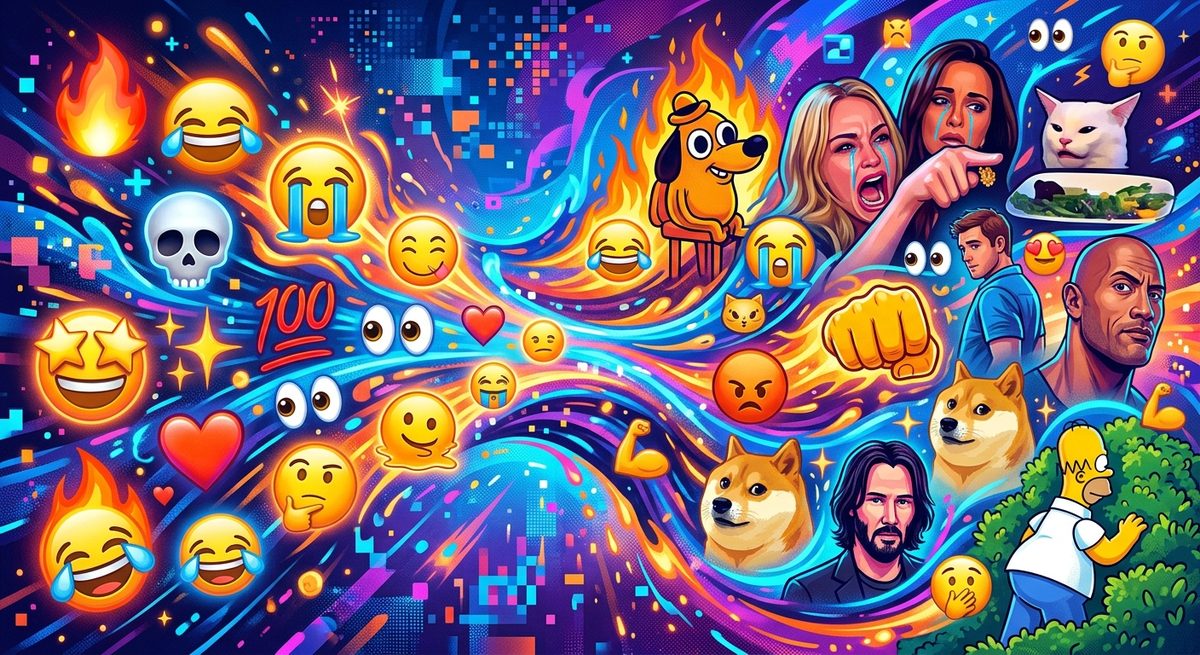
- Emojis and memes spread through identical mechanics: in-group signals, emotional compression, and cross-platform amplification.
- The emojis with real staying power fill an emotional gap that words alone cannot fill.
- Cross-platform movement is what separates a lasting trend from a one-week moment.
The Moment an Emoji Stops Being a Picture
When Unicode releases a new emoji, it arrives as a blank slate. The skull was always there. The melting face (पिघलता चेहरा इमोजी) landed in 2021. The troll (ट्रॉल इमोजी) arrived in 2022. None of them meant anything culturally specific on day one. The official emoji standard defines the character. It does not define what communities will do with it.
Meaning gets assigned by people. A small group starts using an emoji in a specific way. Others pick it up. If it resonates, it spreads outward. If it doesn't, it sits in the keyboard panel forever, sandwiched between symbols nobody ever touches.
That process is not random. It follows a pattern that internet culture researchers have mapped in considerable detail. The same factors that make an image macro explode across the internet are the ones that turn a single yellow cartoon face into a cultural touchstone. The mechanics are shared at almost every stage.
Why 💀 Hit Different and Stayed
The skull emoji is worth examining because its rise was so complete. It replaced "lol," "lmao," and "I'm dead" all at once. It became the default response for anything genuinely funny, absurd, or too relatable to process without falling apart entirely.
What made it work? A few things converged at the same time. It was visually distinct. In a wall of text, a skull pops. It signals high-intensity humor without requiring any surrounding context to land. It also traveled well across platforms, rendering consistently enough that the meaning didn't get scrambled between devices. Consistency matters enormously for any symbol trying to communicate something precise.
It also filled a genuine gap. "Lol" had been drained of meaning through years of overuse. "Lmao" felt dated to certain communities. The skull stepped in as a fresh container for extreme comedic reaction. It communicated "I am deceased" without a single letter. That kind of efficiency is irresistible in digital spaces where every character counts.
In-Group Signals and the Velvet Rope Effect
Here is where the meme comparison gets sharp. Both emojis and memes often begin as in-group signals. A community coins a phrase, an image, a symbol. Using it correctly marks you as one of them. Using it wrong marks you as an outsider trying too hard to belong.
Gaming communities were using 💀 for extreme laughter before the broader internet caught on. Stan culture developed intricate heart emoji combinations with specific hierarchical meanings understood only within the fandom. Crypto communities built a vocabulary around रॉकेट, वाहन इमोजी, खुश होकर दोनों हाथ उठाना इमोजी, and मेंढक का चेहरा इमोजी that functioned as group identity markers as much as anything else. Each time, the emoji stopped being decorative and became a password.
The velvet rope effect is real. There is social value in being an early adopter of a new emoji meaning. You signal that you are plugged in, that you know the reference before it gets explained in an explainer video. That signal is compelling enough that it drives adoption among people on the outside who want in on the joke.
Memes work identically. Knowing a format before it goes mainstream, deploying it correctly in context, not over-explaining it. That is the whole game. The engine powering both is identical.
Emotional Shorthand That Words Cannot Replace
Language is slow. Emotion is fast. Emojis close that gap.
The melting face (🫠) captures something very specific: that particular blend of dread, exhaustion, and resigned acceptance when something bad is unfolding and there is absolutely nothing to be done about it. "I am completely melting with anxiety right now" is nine words. 🫠 is one keypress. That compression is enormous in digital communication, where texts, tweets, and comment replies operate in limited real estate and limited patience.
An emoji that carries a nuanced emotional state in a single character is going to get used. Once it gets used in a way that resonates with enough people, it spreads on its own momentum.
Memes operate on the same principle. The formats that spread farthest tend to be the ones that capture a feeling that is genuinely difficult to put into a sentence cleanly. They do emotional work that language struggles to do with the same efficiency. Trending emojis are doing exactly that, just at a smaller scale and with less visual scaffolding involved.
Cross-Platform Spread Does the Real Work
An emoji that stays inside one community is not a trend. It is a quirk. Real momentum builds only when a symbol starts migrating across platforms and contexts.
TikTok's comment sections accelerate this faster than almost anything else right now. A video uses an emoji in a way that feels precise and funny. Comments pile on using the same symbol. Other creators reference it. It migrates to X, then to Instagram captions, then into Discord servers, then into personal group chats. By the time a brand drops it into a promotional post, the spread is essentially complete.
This cross-platform movement is one of the central forces behind why memes go viral. Content that circulates only inside one platform hits a ceiling fast. The pieces of culture with actual staying power are the ones that punch through into multiple communities and survive the translation between them.
The factors that tend to drive cross-platform emoji migration follow a recognizable pattern:
- A viral video or post that uses the emoji in a way that feels exactly right for a shared feeling
- A high-follower account deploying it in a notable or funny context
- A meme format that fuses itself directly to the emoji's emerging meaning
- A cultural or news moment that the emoji captures better than any available words
Any one of these can create a spark. Two or three together can create something that runs for months and outlasts the original context entirely.
Why Some Emojis Flame Out Fast
Not every emoji makes it. The 🧌 troll had a solid moment. It attached itself to a specific flavor of internet mischief and saw heavy use for a stretch of time. But it never developed the kind of durable emotional meaning that keeps a symbol in regular rotation beyond its launch window.
Compare it to 🫠, which survived because the feeling it represents does not go away. Anxiety is permanent. Resignation is permanent. The melting face has an evergreen use case tied to a universal emotional state, which is exactly why it still appears years after its debut without feeling stale.
Meme formats face the same constraint. Formats tied too tightly to a specific news cycle or cultural flash point have a built-in expiration date written into them from the start. Once the moment passes, the format feels like a relic rather than a living piece of shared language. Emojis that hitch their meaning to a specific passing trend rather than a durable human feeling face exactly the same ceiling.
Durability comes entirely from emotional utility. If an emoji can work across contexts, across years, to express something humans keep feeling over and over, it survives. If it is a one-joke symbol, the clock starts the moment it peaks.
Two Trends, One Playbook
Emojis and memes are technically different things. One is a character managed by a standards body. The other is a cultural format that lives in images and text and video and comments sections. But the mechanics behind their spread are nearly identical at every stage of the journey.
Both rely on in-group adoption to generate early momentum. Both spread through emotional resonance that outpaces literal description. Both depend on cross-platform movement to reach critical mass. And both lose traction once they get over-adopted, stripped of their original meaning, or fused too tightly to a moment that has already expired.
Which emojis become cultural touchstones is never decided in a technical committee or a brand strategy meeting. It is decided by communities, by early adopters, by tight-knit groups who find a new symbol genuinely useful and start using it in ways that make outsiders want in.
That is not a technical process. It is a social one. The same one that has always governed the spread of jokes, slang, references, and shorthand between people who want to communicate faster than ordinary language allows. Trending emojis are the latest format for one of the oldest human behaviors: finding a shared, efficient way to say exactly what you mean, and making other people want to say it too.