AI Image Tools That Work Alongside Emojis for Richer Social Content
Emojis set the expressive tone, but AI-generated imagery fills the visual gaps. Here's how digital creators can use both for richer social content.
Emojis have become a native language of the internet. You drop a face with tears of joy emoji to signal laughter, a fire emoji to show excitement, or a broken heart emoji to communicate something words might struggle to say. They are fast, universal, and woven into almost every digital conversation happening right now. But there is a ceiling to what a small yellow face can do, and that ceiling becomes obvious the moment you need something more personal, more branded, or more visually precise. That is where AI image tools step in, not to replace the emoji but to do the work it was never built for.
Emojis handle tone; AI imagery handles substance, and together they give digital communicators a full creative toolkit.
- Emojis communicate emotion instantly but cannot represent your actual face, brand identity, or custom visuals.
- AI image generators let you create on-brand profile pictures, custom illustrations, and platform-ready graphics with no design skills required.
- Pairing both in your content strategy gives you emotional shorthand and visual depth at the same time.
Why Emojis Alone Have a Hard Ceiling
Emojis started as a way to add warmth to text-heavy messages. The word comes from the Japanese for "picture character," and since their standardization through Unicode encoding, they have grown into a communication standard recognized across virtually every device and platform on earth.
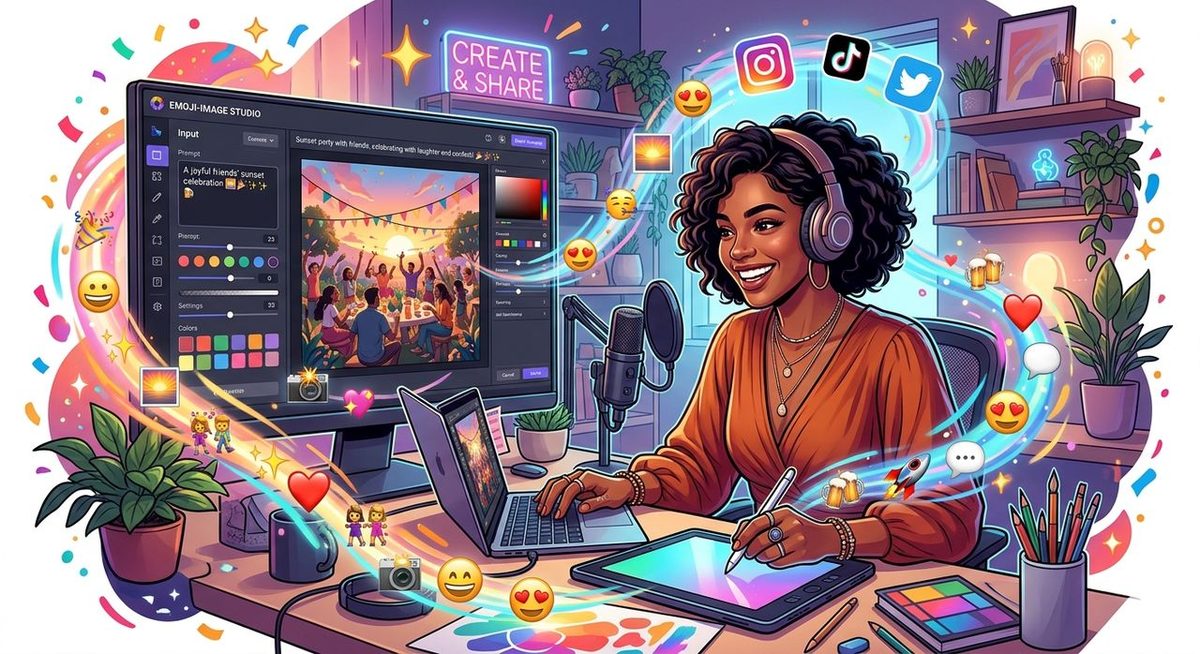
But that standardization is also their limitation. Every person who types smiling face with smiling eyes emoji sees the same small icon, give or take some rendering differences between operating systems. There is nothing individual about it. It signals a mood, not an identity. For personal brands, content creators, and businesses trying to stand out in a crowded feed, relying only on emojis is like trying to furnish a home using only throw pillows. They add comfort, but they do not define the space.
That gap, the space between mood and identity, is exactly what AI image tools are designed to fill.
The Rise of AI-Generated Imagery in Social Spaces
Generative AI tools for image creation have matured dramatically over the past few years. What once required a professional designer or hours of editing work can now happen in seconds. You describe what you want, adjust a few settings, and get back a polished visual that matches your vision.
This matters a lot for social media specifically. Platforms reward consistent, high-quality visuals. Whether you are building a personal brand on Instagram, managing a business page on Facebook, or growing an audience on LinkedIn, what people see is as important as what you say. Emojis can accent a caption, but they cannot carry a post on their own.
The good news is that you do not need to be a graphic designer to produce compelling imagery anymore.
Personalizing Your Digital Identity Beyond a Yellow Face
Your profile picture is often the first visual signal you send to another person online. It appears before they read your bio, before they see your content, and before they form any opinion about your brand or personality. A blurry photo, a generic stock image, or a cropped selfie from three years ago are all missed opportunities.
This is where using an AI avatar creator changes things completely. You can generate a portrait-style image that reflects your aesthetic, your color palette, your professional tone, or your creative personality, without booking a photographer or spending hours in editing software. Want something clean and corporate? Done. Prefer something illustrated and artistic? Also done.
For content creators especially, this matters. Your profile picture follows you everywhere: comment sections, search results, shared posts, and even off-platform mentions. A strong, intentional avatar communicates professionalism and personality at the same time. It says something that the 😊 emoji simply cannot.
Some creators take this further by maintaining variations of their avatar for different platforms, using a slightly more formal version on LinkedIn, a more creative or illustrated style on Instagram, and something playful on Discord or Twitter. AI tools make that kind of flexibility practical and affordable.
When Emojis and Images Work Together
The smartest social content does not choose between text, emojis, and visuals. It uses all three in a deliberate way. A well-crafted post uses words to inform, emojis to punctuate, and images to anchor the whole thing visually.
Here is how that tends to play out in practice:
- The image draws the eye, stopping the scroll before the person even reads a word.
- The caption provides context and value, giving the viewer a reason to engage.
- Emojis break up the text and signal tone, acting almost like punctuation with personality.
- Together, they form a complete message that works on multiple levels simultaneously.
Strip out any one of these elements and the post becomes weaker. The image without the caption feels shallow. The caption without the image competes with every other text post in the feed. And emojis without strong visuals end up looking cluttered rather than expressive.
Getting the Visuals Right for Each Platform
One of the less obvious challenges of social content creation is that different platforms have very different expectations around image format, size, and mood. A square image that looks great on Instagram might feel awkward on LinkedIn. A banner designed for Twitter may not translate to a Facebook header. And what reads as professional on one platform might feel stiff or forgettable on another.
This is why platform-specific planning matters so much. The social media visuals resource addresses this directly by laying out how different platforms call for different treatments, both in terms of technical specs and visual style. Creating content that fits the platform from the start, rather than content that needs manual adjustments for each one, saves time and avoids the small inconsistencies that chip away at how polished your presence looks.
Here are the main variables that differ across platforms:
- Aspect ratio: Instagram favors square or portrait, YouTube favors widescreen landscape, LinkedIn falls somewhere in between
- Mood: LinkedIn skews professional and clean, TikTok prefers raw and energetic, Pinterest rewards detailed and aspirational aesthetics
- Text overlay: Some platforms penalize images with heavy text overlays in their algorithm, while others display text well and reward it
- Resolution expectations: High-resolution images matter more on desktop-first platforms than on mobile-centric ones
AI image tools can be prompted to produce visuals with specific dimensions and moods, which makes adapting your content across platforms faster than it used to be.
What AI Image Tools Cannot Do, And What Emojis Still Handle Better
This is worth being honest about. AI image tools are powerful, but they are not a complete replacement for human creativity or spontaneity.
Emojis win in real-time conversations. If you are replying to a comment, engaging in a live chat, or responding to a story, nobody expects a generated image. A raising hands emoji or a hundred points emoji does the job in milliseconds. Emojis are also cross-cultural shorthand in a way that generated imagery sometimes is not.
Meanwhile, AI image tools sometimes require multiple rounds of prompting to get exactly what you want. The results can be unpredictable depending on the tool and the complexity of the request. And for anything that requires a specific real-world reference, like a photo of your actual product or a candid of your team, AI generation is not the right tool.
The key is knowing which job belongs to which tool. Emojis for emotion and brevity. AI imagery for visual substance and identity. Together, they cover most of what modern social content creation demands.
The Science Behind Why Visuals Matter So Much
Research on visual processing in human communication confirms what most social creators already sense intuitively: images are processed far faster than text and are significantly more likely to be remembered after exposure. That finding shapes how algorithms on social platforms are built. Images and video consistently outperform text-only posts in reach and engagement across most major networks.
This creates a practical pressure on anyone creating content for an audience. Generic images are tuned out. Stock photos can feel inauthentic. The bar for what counts as visually adequate has risen steadily, and AI image tools are one of the clearest answers to that rising expectation.
For emoji-first communicators, the shift is not about abandoning what works. It is about adding a layer of visual strength that emojis were never designed to provide.
Building a Presence That Reads as Intentional
Think of your overall digital presence as a language system. Emojis are the punctuation and emotional annotation. AI-generated imagery is the body language, the face you present, the visual style that signals who you are before a single word is read.
When those two elements are aligned, when the emoji choices feel consistent with the image style and the overall tone of your content, everything reads as deliberate. That is what separates a polished, memorable presence from a scattered one.
For content creators, that alignment is not a luxury. It is the baseline for building an audience that trusts what they see and comes back for more.
Your Visual Toolkit Is More Accessible Than You Think
The combination of emojis and AI image tools is genuinely within reach for anyone creating content today, not just designers or teams with budgets. The tools are simpler than they have ever been, the output quality is higher than most people expect, and the difference they make in how your presence reads is measurable.
Start with your profile picture. It is the one visual that follows you everywhere online. From there, think about how your post images fit the platforms you are publishing on. Let emojis do what they were built for: adding warmth, signaling tone, and punctuating ideas in conversation. Then let AI imagery handle the visual identity work that emojis cannot do.
The combination is not complicated. It is just thoughtful. And thoughtful is exactly what separates content that lands from content that gets scrolled past without a second glance.