How Emojis in Work Emails Actually Affect Your Professional Tone
Emojis in work emails can read as warm or unprofessional depending on recipient age, industry, and platform. Here's how to get the tone right.
You typed a friendly smiley face at the end of your email. You hit send. But what landed in your colleague's inbox might not have felt the same way it felt when you wrote it. A single emoji can come across as warm, sarcastic, flippant, or even disrespectful, all depending on who reads it, what industry they work in, and which device their mail app runs on. For communicators and content creators who already think deeply about what symbols signal, this is fascinating territory.
3 Things to Know Before You Hit Send:
1. Emoji meaning shifts dramatically based on the recipient's age, industry, and cultural background.
2. The same emoji can render completely differently on Apple versus Samsung or Google devices.
3. Subject lines with emojis can lift open rates, but placement and character choice matter more than enthusiasm.
The Generational Gap Is Real
Let's start with something that surprises a lot of people. Younger workers, roughly millennials and Gen Z, generally see emojis in professional messages as humanizing. They signal that you are not a corporate robot. But many Gen X and Boomer colleagues or clients read the same symbols differently. To them, an emoji in a work email can feel lazy, unclear, or a sign that you are not taking the matter seriously.
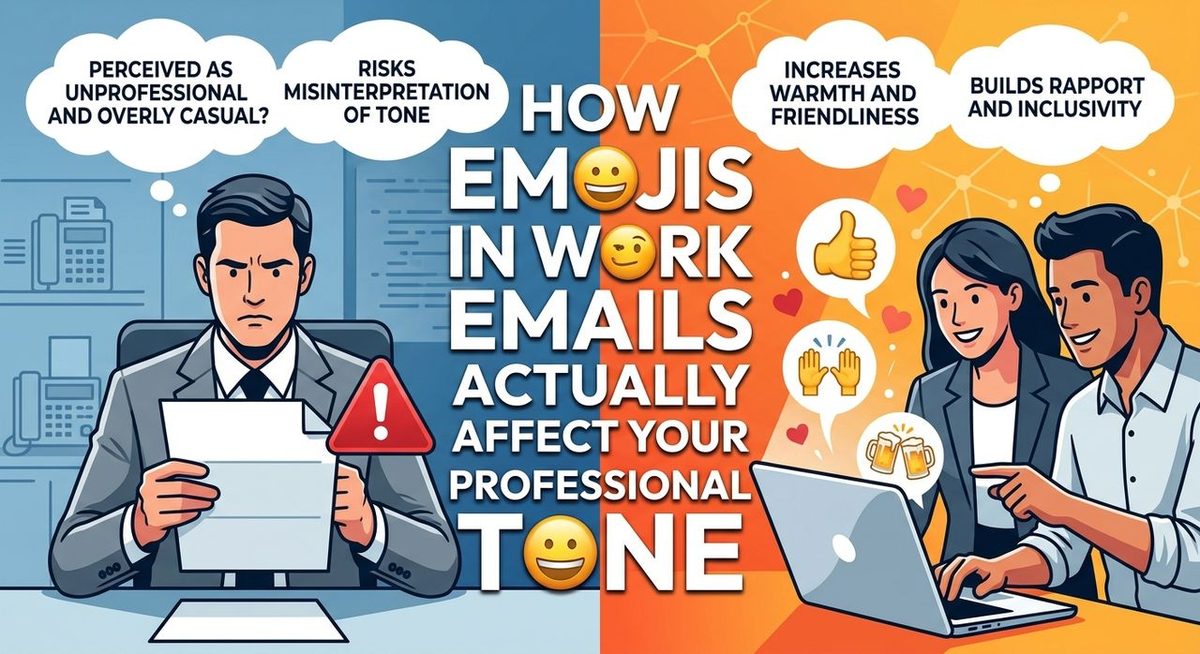
This is not just a vibe difference. Research on workplace communication consistently finds that older recipients rate emoji-heavy messages as less professional, regardless of the message's actual content. The emoji is the loudest thing in the room.
That does not mean you should never use them with senior colleagues. It means you should read the relationship first. If someone has never used an emoji in a message to you, treat that as a signal.
Why Industry Context Changes Everything
A thumbs-up emoji in a Slack message from a UX designer feels completely normal. That same thumbs-up in an email from your tax attorney is going to feel strange. Every professional environment carries its own register, which is the level of formality expected in communication.
Creative industries, tech companies, and media organizations have largely accepted emojis as part of the professional toolkit. Legal, finance, healthcare, and government sectors still operate in much more formal registers. In those environments, even a small smiley face at the end of a perfectly professional email can undercut your authority.
A useful framework for deciding:
- In creative, tech, or startup environments, emojis used thoughtfully can strengthen rapport.
- In traditional or regulated industries, default to plain text unless you have a close relationship with the recipient.
- In client-facing emails to someone you have never met, stay emoji-free until you know their communication style.
The Apple vs. Samsung Problem Nobody Talks About
If you already follow emoji guides, you know that the same emoji does not look the same across platforms. This matters enormously in professional email because meaning can shift based on rendering alone.
The classic example is the "grinning face with smiling eyes" emoji. On some platforms it reads as genuinely happy. On others, the same codepoint renders with a slightly grimacing expression that reads as strained or awkward. The sender meant joy. The recipient sees discomfort.
Emoji encoding and cross-platform standards make clear that each operating system vendor, including Apple, Google, Samsung, and Microsoft, designs its own visual glyphs for the same Unicode character. The underlying code is identical. The image is not.
This is a real communication risk that most people writing work emails never consider. You compose a message on your iPhone, and it reads one way in your drafts folder. Your Windows-using client opens it in Outlook and sees a subtly different face making a subtly different expression.
What This Means for Tone at Work
Tone in written communication is already fragile. You lose vocal inflection, facial expressions, and body language, all the cues that help people interpret meaning in real-time conversation. Paralanguage is the study of how non-verbal signals shape spoken meaning, and in digital text, emojis are sometimes expected to play that same role. The substitution is imperfect.
When you add an emoji to soften a critical piece of feedback, you might be softening it. Or you might be making it seem like you are not taking the feedback seriously. The receiver fills in what they cannot hear.
This is why reviewing your own tone is harder than it sounds. You know what you meant. You cannot unknow it when you re-read your own words. Running your draft through a tone checker before sending can surface how the message reads to a neutral eye, especially in sensitive emails where a single emoji could tip the register in the wrong direction.
The Science Behind Emoji in Subject Lines
Subject lines operate under their own logic. Open-rate psychology works differently there than it does in the body of an email. A well-placed emoji in a subject line can make a message stand out visually in a crowded inbox. But it can also trigger spam filters or feel out of place depending on the email client.
The key variables:
- Placement matters. Emojis placed before the text draw the eye first but can feel aggressive. Trailing placement reads more like natural punctuation.
- Email client support is uneven. Emojis render cleanly in Gmail and Apple Mail, but can appear as garbled characters in older enterprise clients.
- Audience match determines everything. Consumer newsletters tolerate emoji far better than B2B outreach.
- Character count changes on mobile. An emoji takes up visual space, which affects how a subject line truncates on a smaller screen.
If you are testing emoji use in your subject lines and want to pair it with strong copy, a subject line generator can help you draft versions with and without emoji so you can compare how the register shifts across options.
Emojis That Work and Emojis That Backfire
Not all emojis carry the same professional risk. Some have become so normalized in business communication that they pass without comment. Others carry baggage you might not have intended.
These tend to land safely in most professional contexts:
- The thumbs-up, as a brief acknowledgment in low-stakes internal threads
- The checkmark or calendar, in task confirmations or scheduling messages
- A simple smile, in reply to genuinely good news from a close colleague
Strongly expressive faces, anything connected to alcohol or physical comedy, and internet-culture symbols like the flame emoji almost always undermine professional credibility, even in casual work environments. If you find yourself reaching for something that would be at home in a group chat with your friends, that is a useful check-in moment. The fact that it feels natural to you does not mean it reads that way to the person on the other side.
Your Emoji Style Is Part of Your Professional Brand
Every communication choice stacks. Over time, how you use language in email, including whether and how you use emojis, forms a professional identity. Colleagues and clients build an expectation of how you communicate, and those expectations are hard to reset once set.
If you occasionally drop a well-chosen emoji at the right moment in a warm, familiar exchange, that reads as personable. If you use emojis reflexively in every message regardless of context, it starts to read as automatic, and automatic communication is the opposite of considered.
Being intentional here is not about being restrictive. It is about knowing what you are doing and why. You already bring that same care to every other aspect of your content work. Applying it to your email emoji choices is the same skill in a different format.
Sending With Confidence: Owning Your Tone in Every Email
The best professional communicators are not the ones who avoid emojis entirely, and they are not the ones who scatter them through every paragraph. They are the ones who know what a message sounds like to the person who will receive it.
That means thinking about the recipient's age and industry. It means remembering that your smiling face with smiling eyes emoji looks different on their screen than it does on yours. It means re-reading your email not for what you meant, but for what it actually says when the context of your intent is stripped away.
Emojis, used well, can make email feel human. They can signal warmth, close out a tense thread on a lighter note, or confirm shared understanding without adding a whole extra sentence. Used carelessly, they can cost you professional credibility with a single character.
The gap between those two outcomes is almost entirely about awareness. You already have it when you think about what emojis signal in any other context. Apply that same lens to your inbox.