Why a Temporary Email Beats Your Real Address for Most Online Signups
Are temp emails safe to use? Find out why a throwaway inbox protects your privacy and keeps your real address clean for most online signups.
You want to try a new app. It asks for your email. You hesitate, because your inbox is already drowning in newsletters you never signed up for. A temporary email address feels like the obvious fix, but a small voice asks: is this thing actually safe, or are you trading one problem for another? That question is worth taking seriously, and the answer might surprise you.
Key Points:
- Temporary email services generate a disposable inbox you can use and discard, keeping your real address out of third-party databases.
- Reputable services do not retain your messages long-term, and most delete them automatically after a short window.
- Using a throwaway address for casual signups is one of the most reliable ways to keep your personal inbox clean.
- For users whose main concern is staying anonymous online, temp email goes beyond spam prevention into genuine privacy protection.
- Not all services handle data the same way, so knowing what to look for before trusting one matters.
The Safety Question People Actually Search For
The first thing most people Google before using a temp email is some version of "is this safe?" That is a reasonable thing to ask. You are routing a message through a third-party service you have never heard of, and you want to know who else might be reading it.
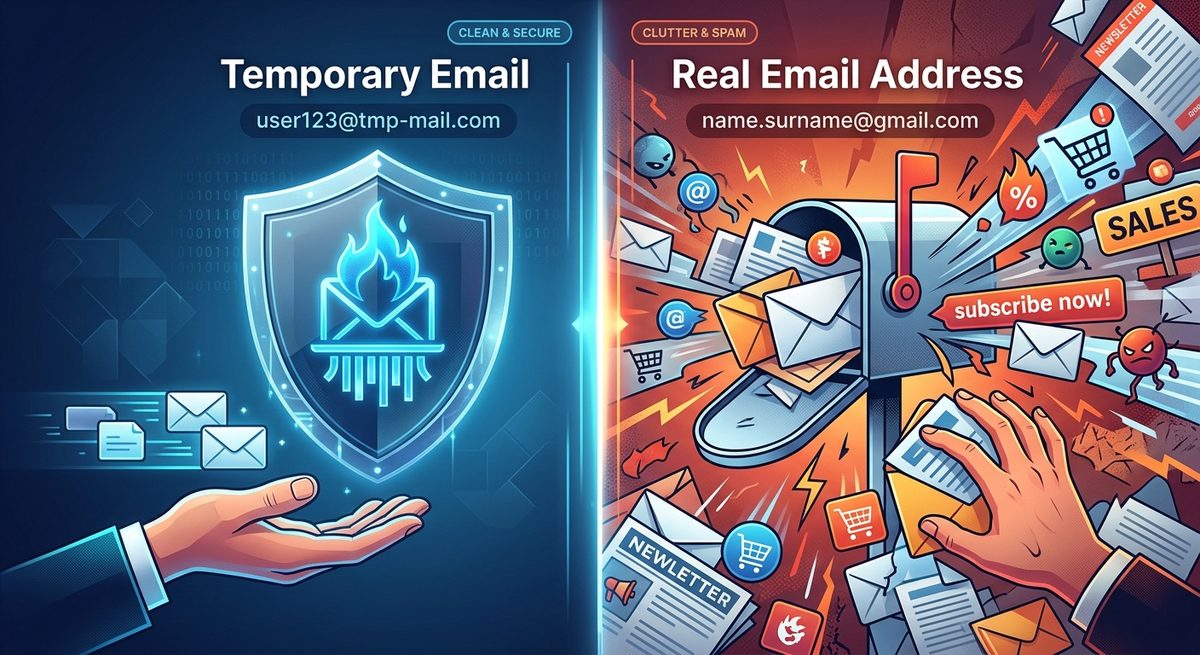
The short answer is that reputable temp email services are designed to be safe for exactly the kind of low-stakes signups people use them for. The longer answer involves understanding what "safe" actually means in this context.
Most temporary email platforms do not require you to create an account or provide any personal information. The inbox is generated on the spot and expires after a set period. There is no registration trail linking the address back to you. That design alone removes a significant layer of exposure.
Where things get more nuanced is message retention. Some services store emails on their servers for hours, some for days, and a few indefinitely. If you are using a temp address to receive a verification code for a free trial, that is low-risk material. If you are using it for anything more sensitive, knowing how long those messages stick around is important.
A detailed breakdown of what actually happens to your messages is covered in this temp mail safety guide, which addresses retention policies, visibility to other users, and what the service does and does not log.
Why Your Real Inbox Is Worth Protecting
According to email spam data on Wikipedia, spam accounts for a substantial portion of all global email traffic. The problem is not just volume. Once your real address lands in a marketing database, it tends to spread. You sign up for one free tool, they share your contact, and suddenly you are on lists you never joined.
This is the everyday problem that temp email solves cleanly. You give the throwaway address to any service that feels optional or experimental. The verification email arrives, you copy the code, and you move on. If that service eventually starts sending daily promotions, they go somewhere you will never check.
For people who sign up for many things, knowing how to avoid spam at the address-entry stage, rather than trying to manage it after the fact, is a much more effective approach. It requires no unsubscribing, no filters, no inbox rules. The address simply expires or gets ignored.
When a Throwaway Address Makes Sense
- Free trials that ask for email before you have decided whether you want the product
- Forum registrations for niche communities you may only visit once
- Downloading a PDF or template that sits behind an email gate
- Testing a product you built and needing a fresh inbox to verify the signup flow
- Entering a contest or giveaway you spotted on social media
When You Should Use Your Real Address
There are situations where a throwaway address will work against you:
- Account recovery, because any password reset goes to an inbox that may no longer exist.
- Ongoing subscriptions, where you need to receive receipts, updates, and billing alerts.
- Professional or legal communication, where a traceable, persistent address matters.
- Purchases, especially anything that might need a return or a dispute resolved.
- Banking or financial services, which verify identity through email and need a stable contact.
Real Address vs. Temp Address: When Each One Fits
Use Case
Real Address
Temp Address
Free trial signup
Often leads to spam
Clean and disposable
Account recovery
Works reliably
Address may be gone
One-time download
Adds to marketing lists
Ideal choice
Ongoing subscription
Necessary
Not suitable
Testing your own product
Pollutes your inbox
Perfect fit
Financial account
Required
Not suitable
The Privacy Angle: Beyond Just Dodging Newsletters
There is a group of people for whom temp email is not really about inbox hygiene. It is about not leaving a trail. Journalists, researchers, and anyone communicating in contexts where visibility matters have real reasons to keep their email address from being tied to their identity.
Disposable email addressing, as the concept is formally known, has been around since the early days of webmail. What has changed is how much personal data can now be inferred from a single email address, given that most people use the same one for years and tie it to their real name, phone number, and location history.
For users in this category, the relevant question is not just "will I get spam?" It is "will this signup connect back to me?" A service built around anonymous email approaches this differently from a basic throwaway generator. It considers what metadata gets attached to your session, whether IP addresses are logged, and whether the address itself can be reverse-searched.
This matters in more situations than people expect. You do not have to be a journalist to have a reason for keeping a signup private. Maybe you are researching a sensitive health topic. Maybe you are checking out a support community you are not ready to join publicly. Maybe you simply believe your reading habits are your own business. All of these are valid.
How Temp Email Actually Works
A temporary email service generates an address, usually something random or customizable, that points to a short-lived inbox. When a message arrives, the service stores it briefly and displays it in your browser session. You read it, take what you need, and the inbox disappears when you close it or the timer runs out.
No login. No password. No personal details attached anywhere.
The disposable nature is the entire point. The address is designed to be used once or a handful of times and then forgotten. This is fundamentally different from alias services, which route mail to your real inbox and require an account. Temp email does not forward anything. It just catches and displays, then disappears.
Why This Beats Filtering After the Fact
A lot of people try to manage unwanted email by building filters, clicking unsubscribe links, or shuffling things into folders. That works, roughly, but it is reactive. You are still receiving the email. Your inbox is still processing it. Your attention is still required, even briefly.
Providing a disposable address at the point of signup means the problem never reaches you. There is no filter to build, no unsubscribe link to chase, no folder to maintain. The promotional emails go to an address that no longer exists or that nobody is checking.
That is a fundamentally different relationship with your inbox, and it only takes a few seconds to set up each time you encounter a sign-up form you feel ambivalent about.
Your Inbox Is Yours: Start Acting Like It
The real address you use every day carries years of context. It is connected to your bank, your friends, your work, your history. Handing it to every service that asks is not a requirement. It is a habit. And like most habits, it is worth examining.
Temporary email gives you a clear way to draw a line between the services you genuinely trust and the ones you are just testing out. The trusted ones get your real address. Everything else gets a disposable one that costs nothing to create and nothing to walk away from.
Whether your concern is a cleaner inbox, a lighter data footprint, or staying genuinely anonymous online, a temp address handles the job with no friction and no ongoing maintenance. Your real inbox will thank you.