The Connection Between Emoji Expressions and Your Actual Face
Discover how emoji designers borrowed from facial science, and how you can map your own expressions back into cartoon form using simple online tools.
You send face with open mouth emoji in a group chat and everyone immediately knows you are shocked. No words needed. That emoji works because it mirrors something real, a specific arrangement of muscles on a human face that your brain is hardwired to read in milliseconds. The science behind that recognition goes back decades, long before the first emoji appeared on a Japanese mobile phone screen. And once you understand it, you start to see emoji not as cute digital stickers but as a compressed visual language built on the deepest patterns of human emotion.
Key Takeaways:
- Psychologist Paul Ekman identified six basic emotions that produce identical facial expressions across all human cultures.
- Emoji designers borrowed directly from that emotional atlas to create icons that feel instantly recognizable worldwide.
- The process can run in reverse: your real face can be mapped onto emoji-style cartoon visuals.
- A cartoonizer converts a photo into a stylized portrait that captures your go-to expression.
- An expression editor lets you fine-tune the emotional output before sharing.
How a Psychologist Accidentally Invented the Blueprint for Emoji
In the 1960s and 1970s, Paul Ekman traveled to remote parts of Papua New Guinea to test a simple hypothesis. He wanted to know whether facial expressions were learned behaviors or universal ones. The people he studied had almost no exposure to Western media. Yet when he showed them photographs of American faces displaying emotions, they identified happiness, sadness, fear, disgust, anger, and surprise with striking accuracy.
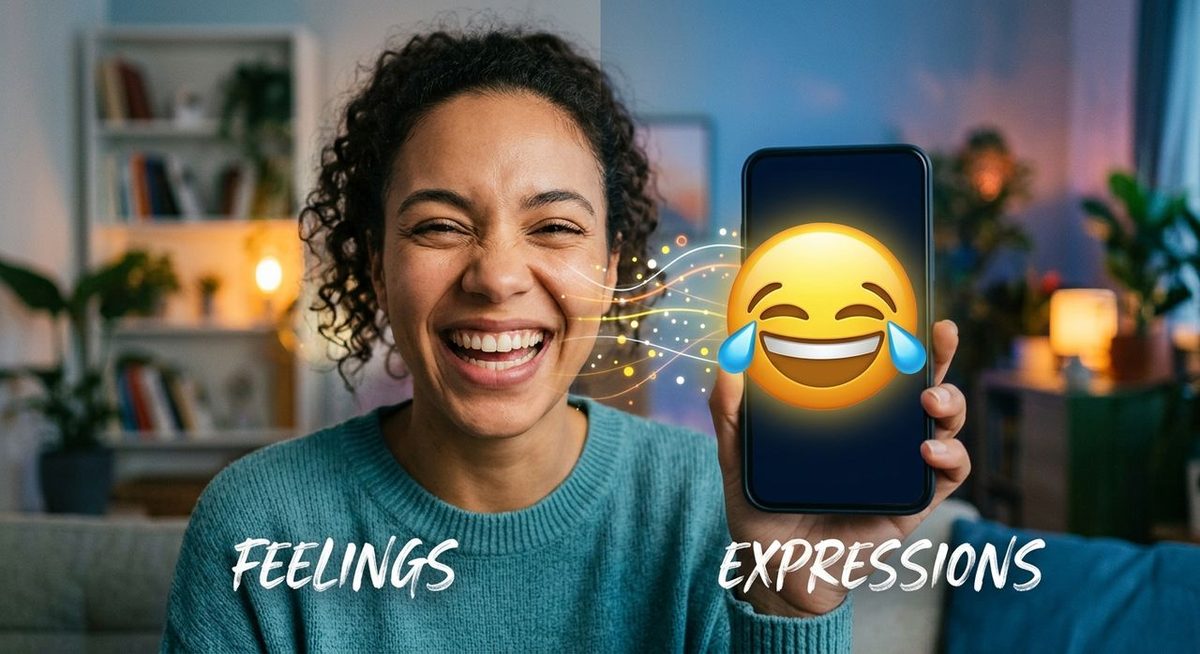
His conclusion, that these six core expressions are biologically hardwired into our species, changed how scientists, designers, and eventually technologists thought about human communication. You can read the full scope of his findings on basic emotions research.
That work became the emotional atlas of the human face. It explained why a raised inner brow paired with a slightly open mouth communicates fear across cultures. It explained why a symmetric lip curl signals disgust in Tokyo, São Paulo, and Oslo with equal clarity. And it quietly gave emoji designers a scientific foundation to build on.
From Research Paper to Pixel Grid
The first emoji were created in 1999 by Shigetaka Kurita for a Japanese carrier. They were tiny, 12x12 pixel images. The face ones had almost no detail. But even at that resolution, the core geometry of human emotion translated. Happiness needed only a curved line for a mouth and two dots for eyes. Sadness flipped that curve. Surprise added wide circular eyes.
What Kurita and later emoji standards committees were doing, largely intuitively, was encoding Ekman's atlas into a visual shorthand. The history of emoji development shows how these small symbols became a universal system precisely because they were rooted in something universal to begin with.
By the time the Unicode Consortium standardized emoji across platforms, the library of face-based icons had grown into a sophisticated emotional vocabulary. Every new face emoji added to the set follows the same underlying logic: replicate the geometry of a real human expression at its most recognizable extreme.
The Six Emotions and Their Emoji Counterparts
Ekman Emotion
Key Facial Signal
Common Emoji Match
Happiness
Raised cheeks, lip corners up
grinning face with smiling eyes emoji smiling face with smiling eyes emoji
Sadness
Inner brow raised, lip corners down
crying face emoji disappointed face emoji
Surprise
Brows raised, mouth open
Fear
Brows raised and drawn together
fearful face emoji face screaming in fear emoji
Disgust
Nose wrinkled, upper lip raised
nauseated face emoji confounded face emoji
Anger
Brow lowered and furrowed
enraged face emoji face with steam from nose emoji
Running the Process in Reverse
Here is the part that gets genuinely interesting. Emoji were designed by studying real human faces and abstracting their essential geometry into stylized images. But what happens when you go the other direction? What if you start with a real photograph and transform it into something that looks like it belongs in that stylized, expressive world?
That is not a hypothetical. It is now a practical option for anyone with a phone photo and a few seconds to spare.
The steps work like this:
- Take or choose a photograph where your expression reflects your go-to emoji mood, whether that is your resting "meh" face, your genuine laugh, or your dramatic shock response.
- Run it through a cartoonizer that translates your real facial geometry into a stylized cartoon portrait.
- Compare the output to the emoji you use most. You may be surprised how closely the cartoon captures your signature expression.
- If the emotion in the output does not feel quite right, open the expression editor to adjust the exact emotional tone before saving or sharing.
- Use the result as a profile picture, avatar, or just a fun artifact of your digital personality.
The cartoonizer does the heavy lifting by preserving the structural features that make your expression yours, the particular angle of your brows, the way your eyes narrow when you smile, the depth of any lines that appear, while translating the whole thing into a visual register that feels animated rather than photographic.
Why Your "Emoji Face" Is Probably Real
Most people have a default expression they reach for in digital communication. Some people are face with tears of joy emoji senders by default. Others lean toward neutral face emoji or face with rolling eyes emoji as their conversational baseline. That tendency usually reflects something genuine about how their faces move.
Ekman's research showed that micro-expressions, the tiny involuntary flickers that cross a face in under a quarter of a second, are almost impossible to fake convincingly. What that tells us is that the expressions we make habitually tend to be honest signals. Your "resting emoji" is probably the expression your face actually settles into.
When you feed that expression into a stylizing tool, you are not creating a fictional version of yourself. You are generating a cartoon that encodes the same emotional information emoji designers have been working with for decades. The cartoon looks like you because the underlying geometry matches. The emotional read feels right because Ekman's atlas was built from faces like yours.
The Spectrum Between Cartoon and Real
One thing worth noting: emoji exist at the extreme end of a simplification spectrum. A 😊 has no nose, no eyebrows, no skin texture, no asymmetry. Real human faces have all of those things in abundance.
Stylizing tools sit somewhere in the middle of that spectrum. They preserve more complexity than an emoji while still shifting the image away from photorealism. That middle ground is where the emotional communication becomes particularly rich. You get the immediate readability of a stylized image with enough personal detail that the result still looks like a specific person, not just a generic face.
This is why cartoon avatars have become so popular across social platforms, games, and professional profiles. They inherit the clarity of emoji-style expression while retaining enough individuality to function as identity markers.
When Your Face Becomes Your Favorite Emoji
The feedback loop between emoji and real faces runs in both directions. We use emoji to communicate emotions we feel too rushed or too awkward to type out in full. We also adopt emoji expressions in real life, pulling the grimacing face emoji face during an awkward moment or the upside-down face emoji look when we are pretending to be fine.
Transforming a photo of your actual face into a cartoon that captures that signature expression is a small but meaningful way of closing that loop. The output is not just a fun image. It is a visual argument that emoji works because human expression is, at its foundation, astonishingly consistent.
Paul Ekman showed that to the world with fieldwork in a rain forest. Emoji designers encoded it into a 72x72 pixel grid. And now a cartoonizer lets you make the connection personal.
Your Face Already Speaks Emoji, It Just Needed a Translator
The science was always there. Emoji drew from it. Real faces confirm it. The only thing that changes when you run a photo through a stylizing tool is that the connection becomes visible in a single image you can save, share, and send.
That cartoon portrait of your surprised face is not a digital novelty. It is the same geometry Ekman documented in New Guinea in 1967, rendered in a style that fits a modern avatar field. The emoji was always based on your face. Now your face can look like the emoji.