Why the Same Emoji Looks Different Depending on Where You Are
Why does the same emoji look completely different on Samsung vs iPhone? Platform, OS, and region all play a role. Here's the full picture.
You send a face with tears of joy emoji to your friend and they reply, "Why did you send me that weird face?" You look at your screen. It looks perfectly normal to you. But on their phone, the same character rendered into something that looks almost unrecognizable. This is one of the most quietly frustrating experiences in modern digital communication, and it happens millions of times a day across the globe. The reason has everything to do with how emoji are designed, delivered, and displayed, and it is more layered than most people realize.
Key Takeaways:
- Emoji are defined by Unicode code points, but each platform draws its own visual version.
- Samsung, Apple, Google, and Microsoft all maintain separate emoji fonts with distinct art styles.
- The region your device is associated with can influence which font version gets served, especially in apps that pull assets from CDNs.
- Running an IP lookup tool shows exactly what region and platform context your device broadcasts to every server it contacts.
- Cross-platform emoji comparison tools, like those on emojiguide.com, reveal just how wide the visual gap can be between implementations.
Emoji Are a Standard, Not a Picture
Here is the first thing to understand. When you tap that laughing-crying face, you are not sending an image. You are sending a text character, a code point defined by the Unicode standard. Unicode is the international system that assigns a unique number to every character in every writing system in the world. Emoji are part of that system.
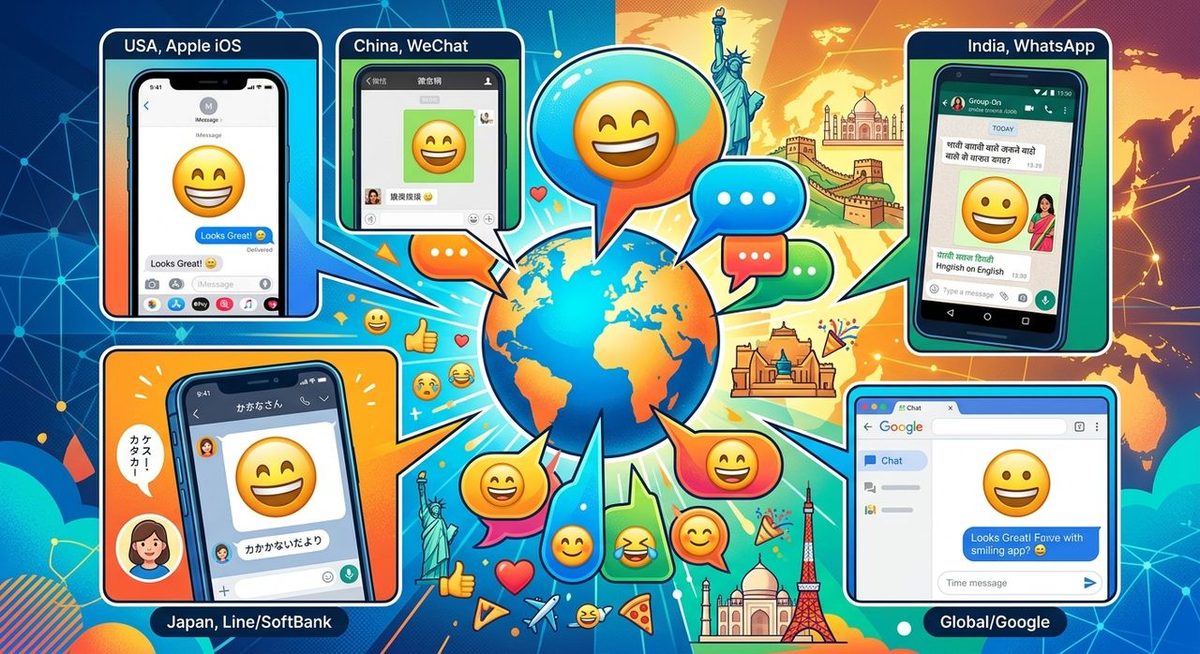
So the character U+1F602, officially named "Face with Tears of Joy," is universal. Every device in the world agrees on what number it represents. What they do not agree on is what it should look like.
That visual interpretation is entirely up to the platform. Apple draws its own version. Google draws its own. Samsung, Microsoft, Twitter, Facebook, each one maintains a separate emoji font with its own art style, proportions, shading, and expression. The code point is a shared language. The face it produces is a local dialect.
Why Samsung and iPhone Emoji Look So Different
Apple's emoji have a photorealistic, rounded, almost three-dimensional quality. They have always leaned into depth, shadow, and smooth gradients. Samsung's emoji, particularly in older versions of One UI, had flatter faces, wider eyes, and a slightly more cartoonish feel. In some cases, the expressions diverge so dramatically that the same code point conveys a different emotional tone depending on which device you are reading it on.
This is not a glitch. It is the direct result of each company treating emoji as a branding asset. Apple considers its emoji part of the iOS visual language. Samsung does the same with One UI. Neither is wrong. They are both valid implementations of the Unicode specification.
The gap becomes a problem in communication. A study examining how emoji meaning is perceived across platforms found that the same face can range from strongly positive to mildly sarcastic depending on the rendering. What reads as genuine laughter on an iPhone might look sarcastic or even unsettling on a Samsung. The sender and recipient are technically speaking the same character but reading entirely different expressions.
The Role of Apps and Rendering Layers
Your operating system is not the only thing that controls how emoji look. Many apps override the system font entirely and serve their own emoji set.
Twitter, for example, uses Twemoji, an open-source emoji set it developed and later open-sourced. If you post an emoji on Twitter and view it in a browser on a Windows machine, you will see Twemoji, not the Windows Segoe UI emoji. The app has stepped in front of the OS.
Facebook and WhatsApp do the same. Instagram tends to defer to the OS on mobile but may use its own rendering in web contexts.
This creates a third layer of variability on top of the OS and the device manufacturer. You could be on an iPhone, using Chrome, visiting a site that loads emoji via its own CDN-hosted font, and the emoji you see are coming from none of the sources you might assume.
Region and CDN Location: The Factor Nobody Talks About
Here is where it gets genuinely interesting and where geography enters the picture.
Some platforms serve emoji font assets through content delivery networks. A CDN stores files in data centers around the world and delivers them from the nearest location to the user. This is efficient. But it means that if a platform has slightly different font versions in different CDN regions, which can happen during rollouts or A/B tests, users in South Korea might load a different version of the emoji font than users in Germany.
This is rare for the largest platforms but common enough in mid-tier apps and web experiences. If you have ever noticed that an emoji looked slightly different on one visit to a website than it did the next day, a CDN cache refresh or regional font version update is a plausible explanation.
Your device's apparent region is largely derived from your IP address. Every time you connect to a server, that server sees your IP and can geolocate you to a country, sometimes a city. That location data informs which CDN node serves you content. It also influences region-specific defaults in apps and operating systems.
What Your Device Is Actually Announcing
This is the part that catches most people off guard. Your device is not just browsing the web. It is actively broadcasting information with every connection it makes. Your IP address reveals your general region, your internet service provider, and your connection type.
For anyone curious about what their device is announcing, running an IP lookup tool makes this immediately visible. You can see exactly what region servers associate you with, which directly ties into the font delivery logic described above. If you are using a VPN or a mobile carrier that routes traffic through a different country, that shift in apparent location can change which assets get served to you.
How Wide Is the Visual Gap? What the Data Shows
Emojiguide.com compiles cross-platform comparison data that makes this concrete. You can look at any given emoji and see side-by-side renderings from Apple, Google, Samsung, Microsoft, Twitter, WhatsApp, and others. The differences are often striking.
Some emoji have converged over time. Apple and Google have nudged certain faces toward more neutral expressions after research showed mismatched emotional readings. But many still diverge significantly.
Here are some of the emoji categories where platform differences are most pronounced:
- Face emoji, particularly those expressing subtle emotions like embarrassment, sarcasm, or mild annoyance
- Hand gestures, where skin tone and finger shape vary considerably
- Food emoji, which often differ in realism versus cartoon style
- Animal faces, where proportions and cuteness levels swing widely
- Flags, which some platforms render as letter codes instead of actual flag images
The Update Problem: Emoji Across Time
Even if you and your friend are on the same platform, you may not be seeing the same emoji if one of you has not updated the OS in a while.
Platforms regularly revise their emoji fonts. Apple has updated the appearance of existing emoji multiple times over the years, sometimes subtly, sometimes significantly. The gun emoji is a well-known example. Apple changed it from a realistic firearm to a water pistol in 2016. Users on older iOS versions still saw the original rendering.
Here is how a misread can unfold across a single conversation:
- Person A sends a syringe emoji as a joke on a fully updated Samsung device.
- Person B receives it on an older iPhone and sees a different visual treatment.
- Person B replies based on their interpretation, which was shaped by an entirely different image.
- Neither person realizes they are looking at different things.
This is not hypothetical. It happens in group chats constantly, and the confusion it causes is often attributed to the wrong source.
Closing: The Invisible Dialect You Are Already Speaking
Emoji were supposed to be a universal visual language. In practice, they are more like a shared vocabulary spoken with dozens of different accents. The code is universal. The face is local. And the region your device sits in, or appears to sit in, shapes more of that experience than most people ever think to question.
Understanding this does not require a technical background. It just requires knowing that when you send a face, the person on the other end may be reading an entirely different expression. The infrastructure behind that gap, platform fonts, app overrides, regional CDN delivery, is real, and it runs quietly beneath every message you send.