Do Emojis in Email Subject Lines Actually Lift Your Open Rates
Do emojis in email subject lines actually boost open rates? Here's what the data really says, plus when to use them and when to skip them entirely.
You have about two seconds to convince someone to open your email. The subject line is everything. So when marketers started dropping fire emoji and party popper emoji into their campaigns, everyone wanted to know: does it actually work, or does it just look desperate?
The answer is more nuanced than most email-marketing blogs will admit. Emojis can lift open rates, lower them, or do absolutely nothing, depending on your audience, your industry, and even which emoji you picked. Let's look at what the research actually shows.
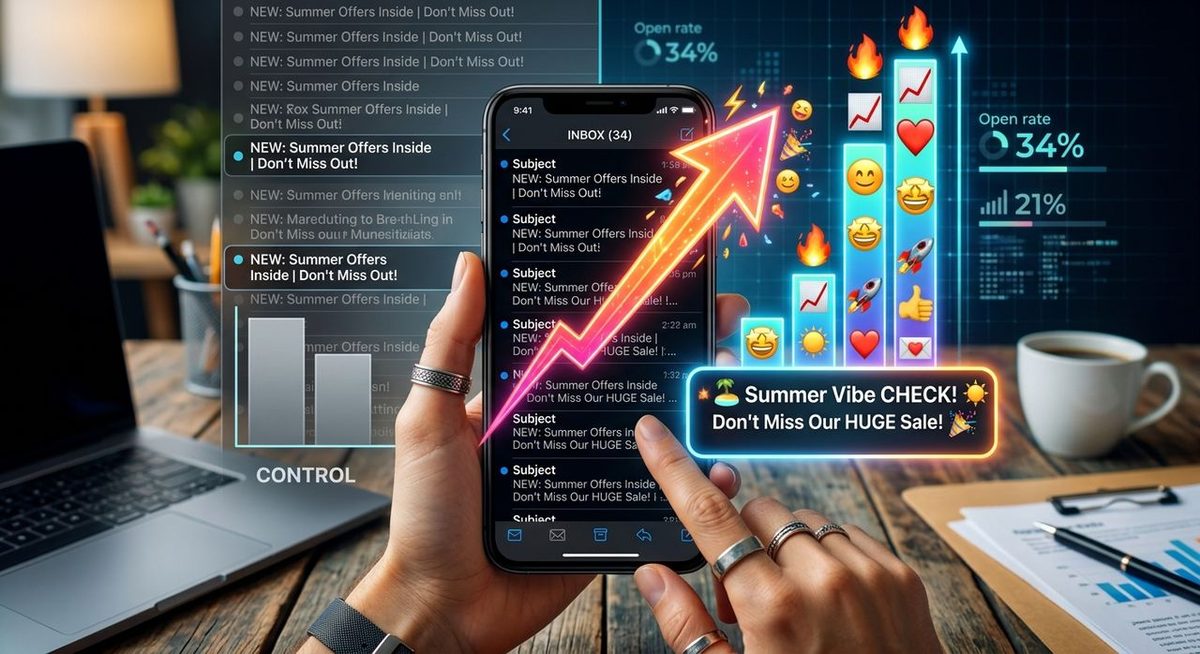
Emojis in subject lines are not a guaranteed open-rate booster. The impact depends heavily on context.
- A single, relevant emoji can increase opens by 25-45% in consumer-facing campaigns, but hurts performance in B2B and formal industries.
- Emoji rendering varies across email clients, and a broken character box is worse than no emoji at all.
- Consistent emoji use across a multi-email sequence matters as much as the individual choice.
What the Data Actually Says
Several large-scale studies have looked at this, and the numbers are interesting. Experian's email marketing reports found that 56% of brands using emoji in subject lines achieved a higher open rate compared to text-only versions. That sounds like a slam dunk, but here's the catch: the average lift was around 25%, and it was almost entirely driven by B2C campaigns in retail, entertainment, and food delivery.
When you look at B2B data, the picture flips. Campaigns targeting finance professionals, legal firms, or enterprise software buyers consistently see open rates drop when emojis appear in the subject line. The reason is simple. Emojis signal informality. For an audience that wants to feel taken seriously, a briefcase emoji in a subject line doesn't add charm. It creates friction.
Email marketing as a discipline has always been about matching message tone to audience expectation. Emojis are just the latest variable in that equation.
When Emojis Help (and When They Hurt)
The Audiences Who Respond Well
Consumer-facing brands in lifestyle, fashion, food, and travel see the most consistent benefits. These audiences expect casual, punchy communication. A well-placed emoji can act like a visual hook, drawing the eye before anyone reads a word of text.
Here's what tends to work:
- Single emoji at the start or end of the subject line (not both)
- Emojis that reinforce the message rather than decorate it (a ☀️ for a summer sale, not just because summer exists)
- Familiar, universally recognized symbols that render correctly across Gmail, Apple Mail, and Outlook
The Contexts Where Emojis Backfire
Some industries are essentially emoji-free zones. If you're sending:
- Legal or compliance updates
- Financial services communications
- Healthcare appointment reminders
- Enterprise SaaS product announcements
Then an emoji in the subject line is more likely to erode trust than build it. A 🎉 before "Your contract renewal is due" feels tone-deaf. That's not a dramatic example. It's exactly the kind of mismatch that damages sender reputation and increases unsubscribes.
The Rendering Problem Nobody Talks About Enough
Here's a practical issue that gets glossed over in most emoji-in-email articles. Emojis don't render identically across every email client and operating system. What looks like a friendly smiling face with smiling eyes emoji on an iPhone can appear as a hollow square on an older Android build or a corporate Windows machine with Outlook 2016.
This isn't rare. It's still a real issue in enterprise environments. And a broken character in a subject line reads worse than plain text. It signals that the sender didn't test properly, which is not a great first impression for any campaign.
The safest emoji categories for cross-client legibility tend to be:
- Basic smiley faces (😊 face with tears of joy emoji smiling face with heart-eyes emoji) from the original Unicode emoji set
- Simple symbols like check mark button emoji, ⭐, and ✉️
- Nature and weather icons like ☀️ and ❄️
- Common objects: mobile phone emoji, light bulb emoji, key emoji
- Hearts and celebrations: ❤️ and 🎉
Complex skin-tone modifiers, newer Unicode emoji introduced after 2020, and multi-part sequences (like flags using regional indicator symbols) are the most likely to break.
Testing Emoji vs. Plain Text
The only way to know what works for your list is to test it. That's not a vague recommendation. It's the single most important action you can take before committing to an emoji strategy.
A subject line generator is useful here because it lets you quickly create paired versions of the same subject, one with an emoji and one without, so you can set up a proper A/B test without spending hours writing variants. The goal is to isolate the emoji as the only variable, keeping word count, phrasing, and offer identical between the two versions.
Run the test for at least two full sends to the same segment size. A single test on a small list gives you noise, not signal.
Tone Is Everything
One thing that rarely gets discussed in the "do emojis boost open rates" conversation is the role of overall tone. An emoji doesn't exist in isolation. It's read alongside the words around it, the sender name, the preheader text, and the brand history the reader already has with you.
A 🎉 in a subject line for a SaaS company announcing a product update can feel exciting. The same emoji in a cold outreach email to a Fortune 500 VP can feel presumptuous. The emoji itself is neutral. The context makes it work or fail.
This is where running your subject line through a tone checker before you hit send can save you from embarrassing misfires. It's easy to think you've written something warm and engaging, but a second pass from a tool designed to catch tonal inconsistencies can flag the moment a 🎉 tips a professional message into something that reads as flippant or overly casual.
Emoji Strategy Across a Multi-Email Sequence
Single campaigns are one thing. The bigger challenge is maintaining consistent emoji use across a series of emails, like a welcome sequence, a product launch, or a nurture drip.
Here's where many brands get sloppy. They use emojis enthusiastically in email one, drop them by email three, and by email five the whole sequence has a schizophrenic personality. Readers notice this more than you'd expect. Consistency in visual tone, including emoji presence or absence, signals professionalism and intentionality.
When building a multi-touch sequence, decide at the start whether emojis are part of your brand voice for this campaign. If they are, plan how they'll appear in each subject line. If you're writing a follow-up email to a cold pitch, the tool can help you maintain the same register and tone across touchpoints so your emoji use (or deliberate absence of it) feels like a choice rather than an accident.
The Frequency Trap
One more data point worth knowing. Brands that use emojis in every single subject line see diminishing returns fast. The novelty disappears. The eye stops catching on the symbol because it expects it.
The brands that see sustained lift from emoji tend to use them selectively, for high-priority sends, for seasonal moments that genuinely call for visual energy, or for campaigns where the audience is already warm and engaged.
Using emojis the same way you'd use bold text in a paragraph works. Using them the way some sites use exclamation points on every line, constantly, frantically, eventually meaninglessly, does not.
What the Numbers Mean for Your Next Campaign
If your audience is consumer-facing, test one emoji against a plain subject line before committing to a strategy. If you're in B2B, default to text and only experiment with low-stakes sends to warm segments first.
Pay attention to which emoji categories render reliably, check your tone before you send, and build emoji consistency into multi-email sequences from the start rather than retrofitting it.
The data doesn't say emojis always work. It says they can work, in the right context, for the right audience, with the right level of care. That's a much more useful takeaway than a flat "yes" or "no."
What This Means for Your Open Rate Strategy
Emojis in subject lines are a real tool, not a gimmick, but they're a precision tool, not a blunt one. The brands that use them well treat them the same way they treat word choice and sender names: as something that deserves testing, consistency, and a genuine match to audience expectations.
The brands that use them poorly are the ones who added a 🔥 to a subject line in 2019 because they heard open rates went up, and never asked a follow-up question.
Your open rate is a signal. Emojis are one input among many. The goal is always a subject line that earns the open because it's relevant and well-timed, not because it's decorated.